Putter Fitting with the Quintic Ball Roll System
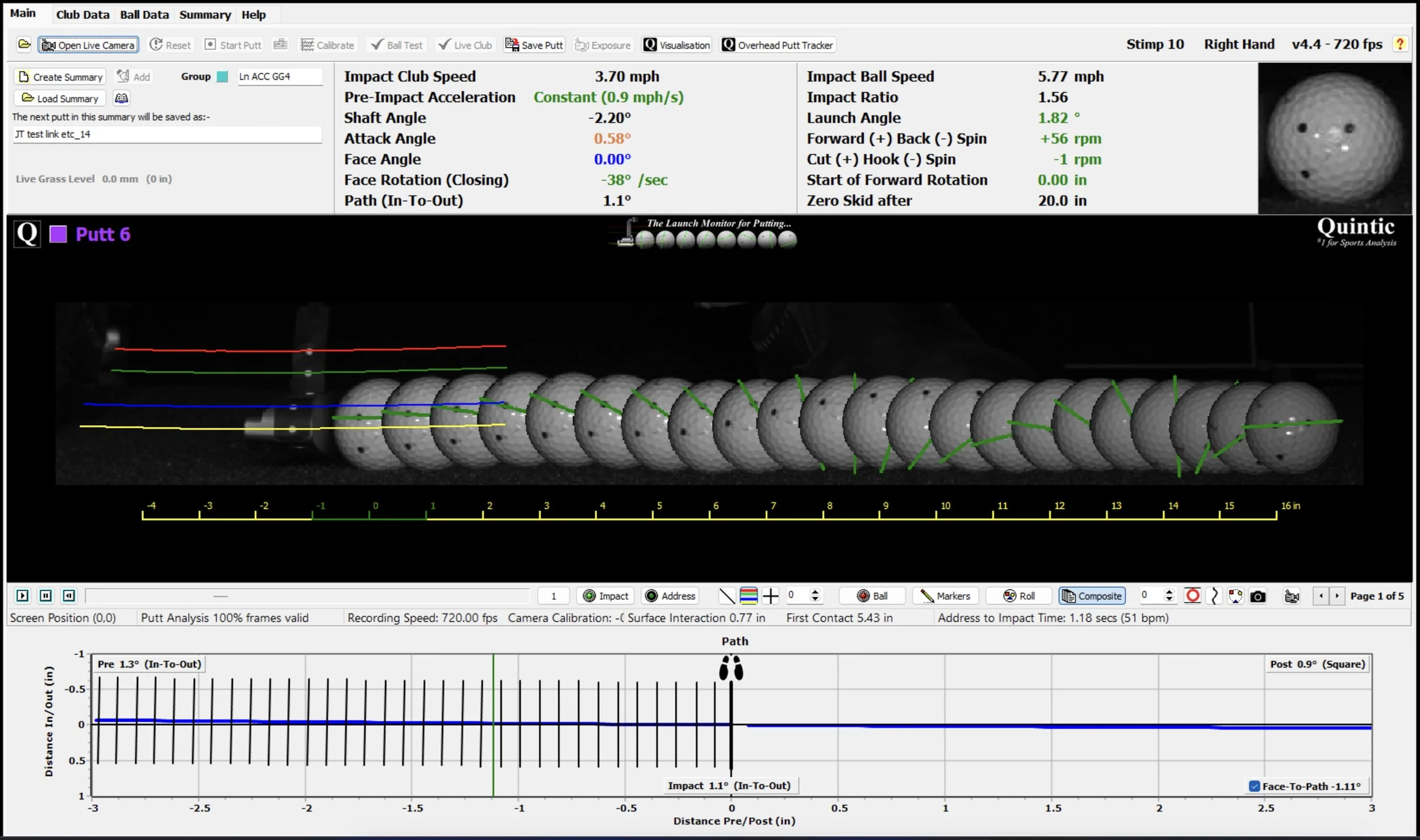
Our goal is to custom fit a putter to each golfer. The optimal length, lie angle, loft angle, and overall weight, and swingweight will be determined. In addition as well as the putter head design, shaft, and grip style will be identified to help each golfer address the ball in an effective posture and align the putter face on line with the desired ball path. These interactions of these factors are unique to each golfer.
Maximizing aiming accuracy and minimizing face rotation at impact are essential elements to understand and optimize. Together with ball speed and launch angle they have significant effects on the roll of the ball after impact. Measuring ball performance is the most meaningful way to determine the effectiveness of a putter or a putting stroke: a putt will be missed by an error of +/- 2º at 5 ft, and +/- 1º at 8 ft.
The Quintic Ball Roll system uses a high speed camera a 720 fps - 1080 fps to track movement of the putter and ball. No device is attached to the putter to affect its movement or balance. More than 50 parameters are measured and displayed in summary tables and graphs. QBR has become the reference standard for putting analysis by many putter manufacturers and tour pro coaches due to its accuracy, wide range of measurements, and refined technology. Despite the wealth of results, the data are relatively easy to understand and use.
A typical putter fitting can begin with repetitions of a straight putt typically 8 ft-12 ft, golfer’s choice. In the above figure we see a subset of key results from a single putt. Results color-coded green or blue are good to excellent, whereas results coded orange or red indicate improvement is recommended or needed. An advantage of having lots of data is that it narrows the view on where to focus improvement effort.
When the ball is launched from its resting place it skids and skips on the turf surface until vertical bounce friction slows its speed and the full circumference of the ball contacts the turf (true roll). Prior to true roll, the putter face at impact determines ball direction and speed. After true roll, turf interaction determines path and distance. The image below shows the vertical bounce pattern of the above ball roll images through the first 16 inches after impact. Excessive vertical bounce can change ball path and reduce the accuracy and distance travelled by the ball.

The image below indicates the putter face aim was identical at address and impact (coded blue). Ball path direction was the same in both backstroke and forward stroke prior to impact. Impact with the ball was slightly toward the heel with a slightly negative twist that closed the putter face (coded green). The low point of the putting stroke arc was an inch behind the ball impact location. Changes in putter lie angle, shaft angle, and attack angle between the address position and at impact are illustrated indicating adjustments to consider for improvement.

The above three figures are from the same putt. Most of the data is quite good but there are three or four modest improvements that could be made.
The analytical depth of the Quintic Ball Roll system allows any golfer to dig deep into their putting technique by tracking how putter/ball interactions affect the results. An extensive set of data located in Summary tables, supplemented with multiple graphs and analytics, can be evaluated in greater detail to understand how putting factors influence ball roll. It’s one of the great strengths of the system.
Lie Angle Balanced Golf
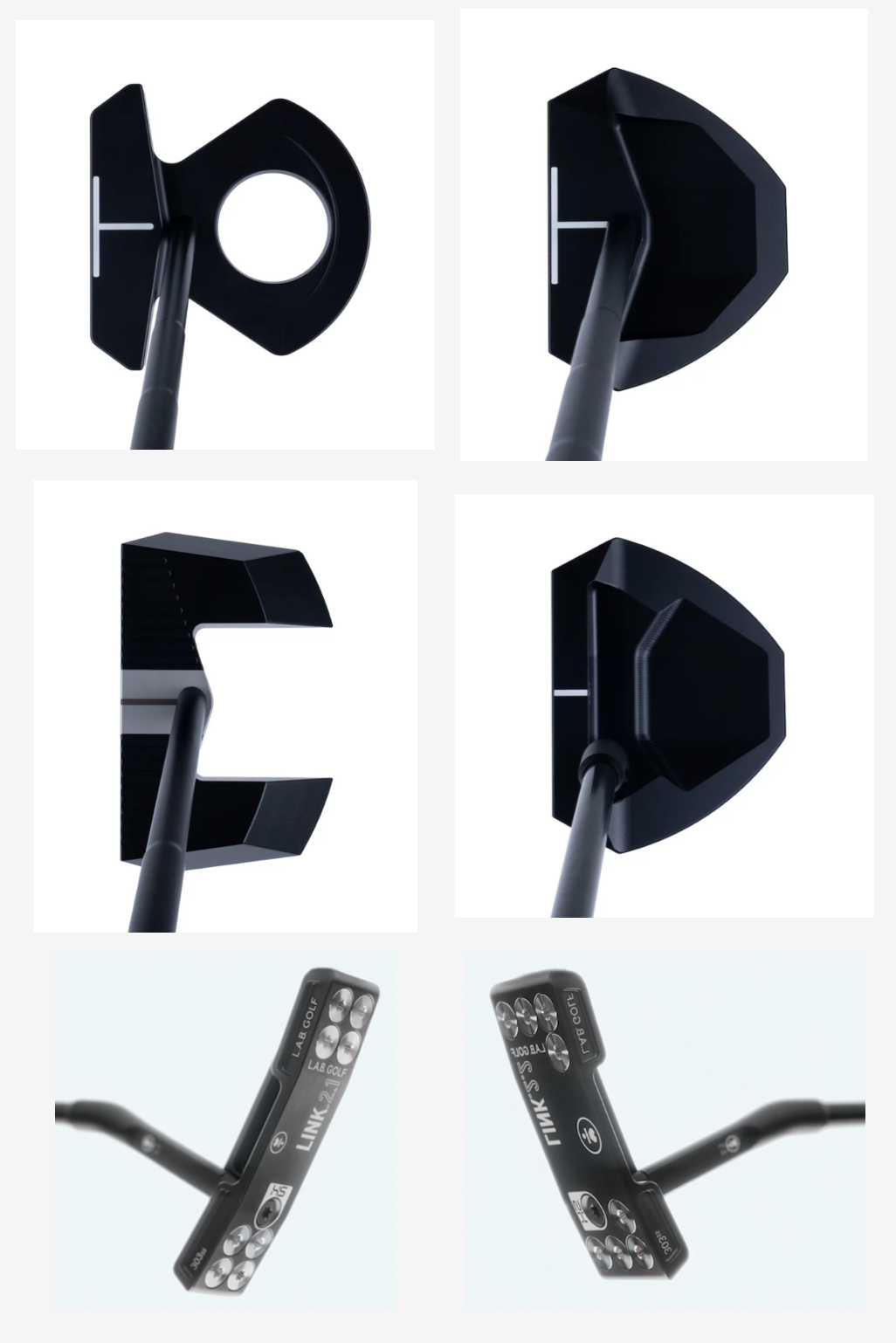
Novel designs by L.A.B. Golf have transformed the putter industry through their zero-torque technology. Models shown here (clockwise DF3, OZ.1, OZ.1HS, Mezz Max, Link 2.1, Link 2.2) are available with an industry-leading wide range of custom options for lie angle, length, weight, and shaft that can fit all golfers.
Zero-torque technology can be seen in the vertical orientation of the putter face when the club shaft is supported at its horizontal balance point. This zero torque effect naturally aligns the putter face to be perpendicular to the path of the putter during a putting stroke and through impact. It allows the golfer to let the putter guide itself along the putting stroke path.
Fitting with Quintic Ball Roll analytics together with L.A.B. test putters allows golfers to identify the best combination of options and design that complements their individual tempo and vision. We find one design option in particular stands out: lie angle.
ADVANTAGES OF HIGH LIE ANGLE PUTTERS
Golfers can benefit from playing putters with higher lie angles than are conventionally recommended. High lie angles help optimize posture at address and improve accuracy in aiming the putter. The curve in the lateral arc of the putting stroke is reduced, minimizing timing errors at impact and improving ball path. A higher lie angle putter at optimum length for your posture maximizes performance of L.A.B. zero torque designs.
L.A.B. Putter Designs
Contact JTClubs for Putter Fitting
Interested in Putter Fitting? Enter your info and let’s schedule a fitting to find the optimal putter for you. We can also analyze the capabilities of your current putter.
During the process we can take a detailed look at your address posture in setting up for a putt, how you grip the putter, as well as aiming and managing face control of the putter in the impact zone. We can evaluate your putting tempo — important for distance control, and if your putter is at constant speed through impact (desirable) or changing speed (not desirable). It’s critical to understand these elements of your putting stroke mechanics to determine the optimal putter design, shaft, grip, and overall properties to be built into your new putter. You can personally measure the beneficial effects of L.A.B. putter design features compared to the alternatives.
Quintic Ball Roll Research System, Accredited Center since 2023
L.A.B. Golf, Authorized fitter since 2024
EvnRoll authorized fitter since 2024
jtclubs@gmail.com 415 587 9815
Quintic Putting
Filters
No results found
No results match your search. Try removing a few filters.